This listing hasn't been claimed by Andertons Music Co. yet — this item's details and price were compiled by JustVybe from publicly available sources and have not been checked or confirmed by the business.
Last updated 28 Nov 2026.
Last updated 28 Nov 2026.
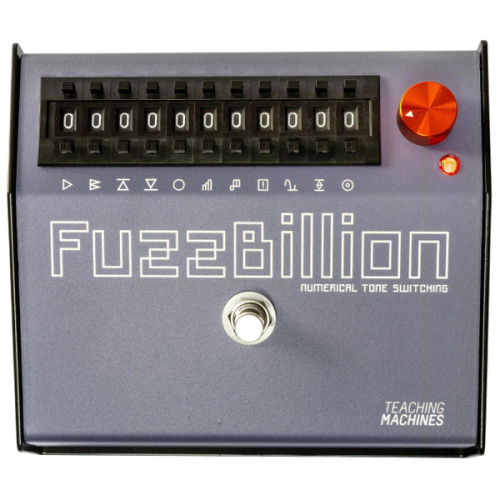
Teaching Machines FuzzBillion Distortion Device Pedal
£519.00
Effects Pedals
SKU: ANDERTONS-53058
Delivery & collection
Collection available
UK-wide shipping
Contact business to arrange
Check with the business for delivery charges, minimum orders and any address restrictions.
If you’ve ever wished your gain pedal had more buttons to twiddle, more tones to unleash and more sheer madness to explore, you’ll love the Teaching Machines FuzzBillion. This beast is a distortion playground for guitar, bass and synths — packed with numerical switches that let you sculpt gain far beyond anything a “normal” distortion box could ever dream of. Simply spin the numbers to jump from subtle low‑gain overdrive to full‑on screaming distortion and fuzz.
Totally analogue, totally bonkers!
Inside the FuzzBillion lives a zoo of clipping components (germanium, silicon, LEDs) all feeding through a left‑to‑right signal path that’s designed for deep, tweakable chaos. Change something early in the chain? It’ll reshape everything that comes after it.
Billions of combinations
This pedal isn’t just versatile — it literally has billions of possible settings. And don’t panic about changing up your fave, meticulously crafted tone. That’s because each sound corresponds to a physical number, so you can just jot down the combination or snap a pic with your phone and get your exact tone anytime. There’s even a dedicated space in the manual to store your favourite discoveries.
What does each control wheel do?
Here’s your guided tour of the FuzzBillion’s eleven numerical tone-shapers, from left to right. Each wheel turns using those delightfully clicky little plungers:
Wheel 1 (gain boost)
Positions 1–4 give you clean(ish) op‑amp boost tones.
Positions 5–8 unleash a gnarlier, gated transistor fuzz.
Setting 9 is an even more extreme version of positions 5-8, adding a second transistor in series.
0 is bypass.
Wheels 2, 3 & 4 (clipping amplifiers)
These three wheels shape the main clipping amplifier. Together, they transform the texture of the distortion in wonderfully weird ways:
Wheel 2 = more gain.
Wheel 3 = affects negative clipping (top of the waveform).
Wheel 4 = affects positive clipping (bottom of the waveform).
Wheel 5 (tone)
0 is the darkest and most bass-heavy.
1-8 increases in brightness.
9 removes the EQ entirely and gives you a passive level boost.
Wheels 6 & 7 (octave fuzz)
Octave fuzz works by flipping the lower half of the waveform, giving you that screaming octave-up effect.
Wheel 6 = octave fuzz drive.
Wheel 7 = blend amount.
Note: Wheel 6 only becomes audible when Wheel 7 is above 0.
Wheel 8 (PLL)
The phase‑locked loop is basically an oscillator trying desperately to follow your pitch. Different settings change how fast and how accurately it “locks on.” Expect glitchy, robotic, bizarre noises (but it needs a strong, high‑gain signal — otherwise it might do nothing at all).
Wheel 9 (bias offset)
This shifts the waveform up and down, causing intentional asymmetric clipping. It can sound chopped, broken, splattery or magically musical. Just give the circuit a few seconds to stabilise after changing the setting. 0 is the cleanest, most neutral bias point.
Wheel 10 (output clip)
Near the end of the signal path, this wheel adds a more traditional diode‑based clipping stage. It can reduce perceived gain while giving you longer sustain and smoother fuzz textures. It also interacts with everything that came before it — sometimes beautifully, sometimes brutally!
Wheel 11 (output tone)
A simple low‑pass filter:
0 = bypass (maximum treble).
1–9 = progressively darker.
Dial it back to taste depending on how feral things have gotten upstream. And that big red dial on the right of the pedal? That’s your master volume.
Key Features
11 tone‑twisting numerical switches: Unlock a universe of distortion flavours with eleven clickable number wheels that reshape your gain in wild and unpredictable ways. Every digit takes you somewhere new.
100% analogue circuitry: No menus, no algorithms — just pure, old‑school analogue goodness. It’s all about authentic clipping, real components and that unmistakable organic feel.
Input guitar/line switch: Whether you’re plugging in a guitar, bass, synth or studio line source, the FuzzBillion has you covered. A side‑mounted push switch lets you choose between a hi‑impedance unbalanced guitar input (pushed in) and a low‑impedance balanced line input (out), with a handy LED lighting up to confirm you’re in line mode.
Output guitar/line switch: Match the pedal perfectly to whatever you’re running into next. The second push switch selects either a hi‑impedance unbalanced guitar output (pushed in) or a low‑impedance balanced line output (out), making it just as at home on a pedalboard as it is in a studio patch bay.
Specifications
Power Requirements: 9V DC (centre negative, 50 mA)
Dimensions: 17 x 14.5 x 8 cm
Weight: 1.4 kg
Supplier product code: FUZZBILLION
Official product information: https://www.andertons.co.uk/teaching-machines-fuzzbillion-pedal/
Published prices and availability are a snapshot. Contact Andertons directly to confirm current stock, collection and shipping arrangements.
Catalogue item — contact the business to enquire.
Back to shop